
IP, IPR, financing – what is it all about?
What are we actually talking about when we talk about intangible capital and intangible assets?
Three challenges
- The variety of terms makes shared understanding difficult
- Intangible capital isn’t recognised as a key factor of production for the company
- The role of intangible property and its legal protection in creating company value remains unexploited

The three elements of intangible capital
The largest determinant of a company’s market value is its intangible capital (Intangible Capital, IC). It rests on three factors:
1.
Human Capital
2.
Structural Capital
3.
Relational Capital
Intangible property (Intellectual Property, IP) is created when intangible capital is put to creative use. Examples of IP include inventions, creative works, names, logos, artistic works, databases, and various documents. Intangible capital and intangible property form the core foundation of a company’s value creation – two expressions of the same underlying intangible element.
The importance of intangible capital
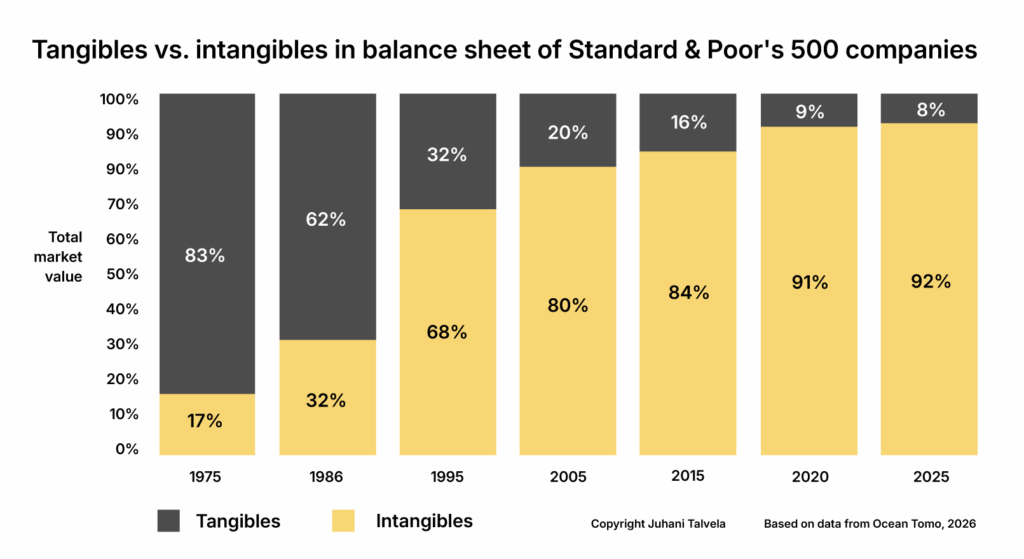
Intangible capital is a key factor in determining a company’s value. In practice, the more intangible capital a company has, and the stronger it is, the more valuable the company becomes.
The chart below shows how intangible capital’s share has grown to become the most important factor in a company’s stock market value. Click to enlarge.
Protection of intangible assets
The IP developed by a company is valuable, and it’s often sensible and profitable to protect it. Formal IP protections (Intellectual Property Rights, IPR) – such as patents, utility models, trademarks, and design rights – are assets that can be used in the company’s own operations, licensed to third parties, or sold. The company name, domain names, and other protections used in business are also part of a functioning company’s IPR portfolio. The most important non-registrable IPR right is copyright and its related rights.
IP protection can also be achieved without expensive, demanding processes, using alternative protection methods. Speed-to-market, complexity, and bundling are common approaches used instead of formal protection. The best outcome is often achieved by combining different protection methods (or choosing not to protect at all). However, these decisions should always be based on knowledge and understanding, as well as sound business planning.
Intangible asset management
A company’s intangible capital, the intangible property (IP) it creates, and its IPR protections all need to be managed effectively. This requires understanding and expertise, as well as good tools and methods. As a management tool, an IP strategy (or IP action plan) links to the company’s overall strategy and business plan, supporting their implementation. An IP strategy determines what the company will do, and how, to develop, identify, protect, and make use of its intangible capital and IP.
Terms and abbreviations
IP/IPR – Intellectual Property
Intangible property (IP) and the legal protection covering it – patents, trademarks, copyright, and trade secrets.
IPR Valuation
Calculating the monetary value of intellectual property rights – used in investment negotiations, licensing, and mergers and acquisitions due diligence.
TM / ® – Trademark
TM denotes an unregistered trademark established through use. The ® symbol denotes a registered trademark, name, or logo that distinguishes a company’s products or services from others.
© – Copyright
Automatic protection for original works (artistic works, literature, software, performances, 3D models, etc.). Copyright arises for the creator without any registration requirement.
NDA – Non-Disclosure Agreement
An agreement in which the parties commit to keeping shared information confidential. Essential, for example, before disclosing an invention.
FTO – Freedom to Operate
An assessment of whether a product or solution can be commercialised without infringing a third party’s valid patents.
UM – Utility Model, Petty Patent
A lighter way to protect a technical invention. Faster and cheaper to register than a patent, but with a shorter protection period (10 years in Finland). Especially suited to small companies and fast-developing products.
First Filing – First patent application
Priority Filing. The first patent application filed for an invention, which sets the priority date and, based on that date, the potential validity period of a future patent. Follow-up applications must be filed within 12 months of the first application. Any patents granted based on those follow-up applications remain valid for a maximum of 20 years from the priority date.
EPO – European Patent Office
The European Patent Office, which grants European patents under the EPC on behalf of 40 member states.
UP – Unitary Patent
An EU patent introduced in 2023, valid in all participating EPO member states through a single registration.
WIPO – World Intellectual Property Organization
Handles PCT patent applications, as well as trademark and design applications, for around 157 countries.
PCT – Patent Cooperation Treaty
An international agreement that allows a single application to be filed in over 150 countries simultaneously.
Where do you stand in the IP game?
Let’s plan the basics of your IP operations and IP strategy together. Tell us about your situation and needs.
Send a contact request, and we’ll map out the situation together, with no commitment required.

Financing solutions
How is financing planned?
A company’s day-to-day operations revolve around invoicing and cash flow, but moments of growth, development, and risk management often call for separate financing. Money is also needed when a business is starting up, developing a solution, or opening up new markets. In short, financing becomes necessary whenever a situation departs from the everyday – and finding the right solution takes careful consideration, preparation, and hard work.
Financing solutions mean comprehensively examining, evaluating, and defining what the financing is for, which instruments will be used, how repayments are scheduled, and how the financier is reassured of all this. Well-planned financing lets a company carry out its project without cash-flow crises, while also keeping its operations credible, transparent, and realistic in the eyes of financiers.
Why is financing planning – and delivering a project successfully – so demanding?
- A financing need is an exception to a company’s normal day-to-day operations – it must be approached as a strategic decision
- The right financing model reduces risk and keeps the business progressing in a controlled way
- A clear, well-founded, and realistic implementation plan must be presented to the funder
- A well-structured funding package speeds up decisions and increases the likelihood of a positive outcome
- A project plan takes care to prepare – it’s not routine work, but requires time, background research, and a solid understanding of funding criteria and conditions
- Professional support reduces the delays and errors that can affect access to funding
Intellisys helps companies build a clear, well-founded, and feasible financing plan – and apply for financing based on it – to support the company’s development and growth.
The most common sources of financing in Finland
- Crowdfunding – equity- and debt-based models
- Public funders – Business Finland, Economic Development Centres, rural development funds, regional development support
- Banks and loan instruments – product development loans, investment and working capital loans, Finnvera guarantees
- Private equity investors – venture capital funds and growth funds
- Business angels – early-stage financing and expertise
- Grants and foundations – especially for research and development projects
- Project funding – for example, EU structural funds and regional development projects
- Seed and pre-seed funding – for early-stage growth companies
Terms and abbreviations
VC – Venture Capital
Professional equity investment in early-stage, high-growth-potential companies in exchange for an ownership stake.
Series A/B/C – Funding Round A/B/C
Successive equity investment rounds. Series A: product-market fit. Series B: scaling. Series C and beyond: expansion.
Grant / Subsidy
Non-repayable funding from a public source (e.g., Business Finland, Horizon Europe) for R&D activities or innovation.
EIC – European Innovation Council
An EU body that funds breakthrough innovations and growth companies through grants and equity investments.
NPV – Net Present Value
The present value of future cash flows, discounted – a key tool in investment decisions and IP valuation.
IRR – Internal Rate of Return
The discount rate at which an investment’s NPV equals zero – used to compare different investment options.
LOI / TS – Letter of intent / Term sheet
A non-binding document outlining the key terms of a deal or investment before the final agreement.
Cap table – Ownership Structure
A table showing a company’s ownership structure: shareholders, ownership percentages, and share classes. Essential in financing negotiations.
T&K / R&D – Research and Development
Activity aimed at developing new products, processes, or knowledge – the main source of patentable inventions.
TRL – Technology Readiness Level
A 1–9 scale describing a technology’s stage of development, from basic research (TRL 1) to full operational deployment (TRL 9).
PoC – Proof of Concept
Evidence that an invention or idea is technically feasible – not yet a market-ready product.
MVP – Minimum Viable Product
The smallest working version of a product, built to test user hypotheses with the least possible development effort.
SME – Small and Medium-Sized Enterprise
Under the EU definition, a company with fewer than 250 employees (turnover ≤ €50 million). SMEs receive discounts on EPO patent fees.
Intellisys services for small and mid-size enterprises
Intellisys offers comprehensive services for identifying, managing, and proactively developing intangible assets. The most effective solutions come from combining IP/IPR services with tailored financial coaching.